
The half-marathon covers 21.0975 km. At this distance, the finishing time depends on three main variables: gender, age, and the runner’s training level. According to data aggregated by Marathon Handbook from over 124,000 finishes, the overall average across all categories is around 1 hour 50 minutes 15 seconds, a figure that masks very different realities from one profile to another.
Pace and finishing time: understanding what the numbers measure
Before comparing a time to an average, it is important to distinguish between two often-confused concepts. The chip time corresponds to the actual time between crossing the start line and the finish line. The gun time, on the other hand, starts at the sound of the gun, even if the runner takes several minutes to reach the line. In large events, the gap between the two can exceed two minutes.
The pace, expressed in minutes per kilometer, better reflects the actual effort. A half-marathon completed in 1 hour 45 minutes corresponds to a pace of about 5 min/km. A time of 2 hours 10 minutes places the pace around 6 min 10/km. Thinking in terms of pace rather than raw time allows for setting a goal of consistency, kilometer after kilometer.
To accurately situate the average good time for a half-marathon, it is necessary to cross-reference gender, age group, and weekly training volume. A global average is not sufficient.
Average time in the half-marathon by gender
Data from several result databases converge on a stable observation: men finish on average around 2 hours 01 and women around 2 hours 12. This gap of about ten minutes reflects physiological differences (muscle mass, maximum oxygen uptake, hemoglobin levels) that persist regardless of training level.
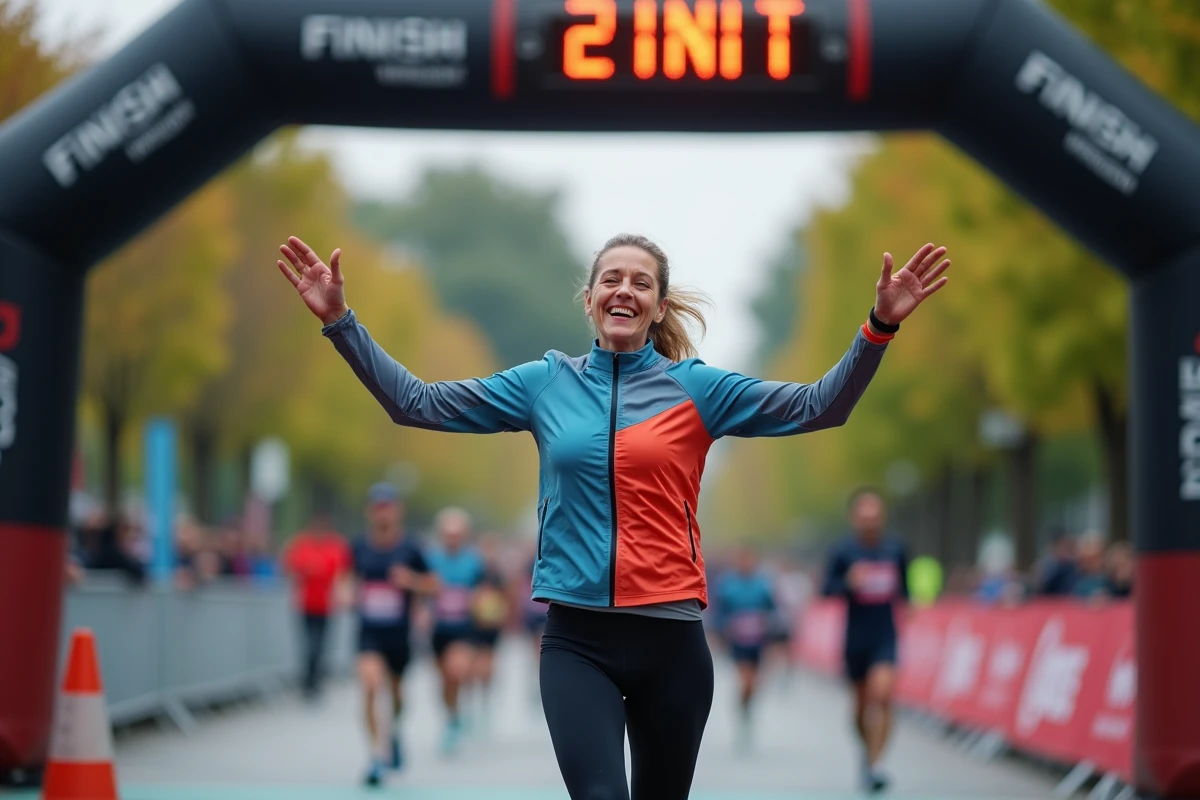
The gap slightly narrows among highly trained runners and widens among beginners. Average female performances remain structurally further from the so-called “intermediate” times than male performances, making direct comparisons between genders less relevant without further breakdown by age group.
A point rarely emphasized: the proportion of women in half-marathon fields has significantly increased in recent years. This democratization has mechanically pulled the female average upwards (i.e., towards slower times), without indicating a decrease in level. The phenomenon is similar among men, but to a lesser extent.
Average time in the half-marathon by age group
Age acts as a factor of gradual degradation of times. Peak performance generally occurs between the ages of 25 and 34, after which the average time increases steadily with each decade. Here are the major trends observed in the result databases:
- Between 20 and 29 years, runners show the fastest times, driven by a peak in VO2max and effective recovery.
- Between 30 and 39 years, the decline remains modest (a few minutes on average). Many runners achieve their best time in this range due to superior tactical experience.
- Between 40 and 49 years, the degradation slightly accelerates, but regular training helps limit the gap with the previous decade.
- Beyond 50 years, each decade adds a more pronounced slowdown, related to the loss of muscle mass and decreased cardiovascular capacity.
A 45-year-old runner finishing in 1 hour 55 minutes achieves a performance comparable, in relative terms, to that of a 28-year-old runner finishing in 1 hour 45 minutes. Age grading tables allow for comparing times between generations on an equitable basis.
Setting a realistic goal based on your runner profile
Rather than aiming for the overall average, it is more useful to position oneself relative to one’s own running history. The half-marathon is the most predictable distance based on a 10 km time: multiplying your 10 km time by a coefficient close to 2.22 provides a reliable estimate of the achievable half-marathon time, provided you have an appropriate training volume.
Three criteria help refine the goal:
- The weekly volume: running regularly three to four times a week, with at least one long run, is the minimal foundation for completing a half-marathon without walking.
- Competition experience: a first half-marathon is rarely run at optimal time. Managing effort over 21 km is learned, and most runners improve their time by several minutes on their second attempt.
- Race conditions: course elevation, temperature, and wind significantly affect the time. A half-marathon run at 28 °C cannot be compared to one run at 12 °C.

A common pitfall is starting too fast in the first five kilometers. In a half-marathon, a too-quick start will always pay off after the fifteenth kilometer, with a collapse in pace that costs much more than the seconds gained at the start.
Why the overall average of a half-marathon keeps increasing
The average times published today are slower than they were fifteen or twenty years ago. This trend does not reflect a decline in collective level. It results from the massive widening of the participant base: more casual runners, more first-time half-marathoners, and more people whose goal is to finish rather than to perform.
Coaching platforms and federations now prioritize standards by age group and gender rather than a single average. This approach provides a more honest benchmark. Comparing oneself to the overall average ignores half of the variables that determine a time.
A regular runner finishing their half-marathon in the upper range of their age group has no reason to consider their time as mediocre, even if it exceeds the often-cited average of 2 hours. The only time that really matters is that of the previous race.