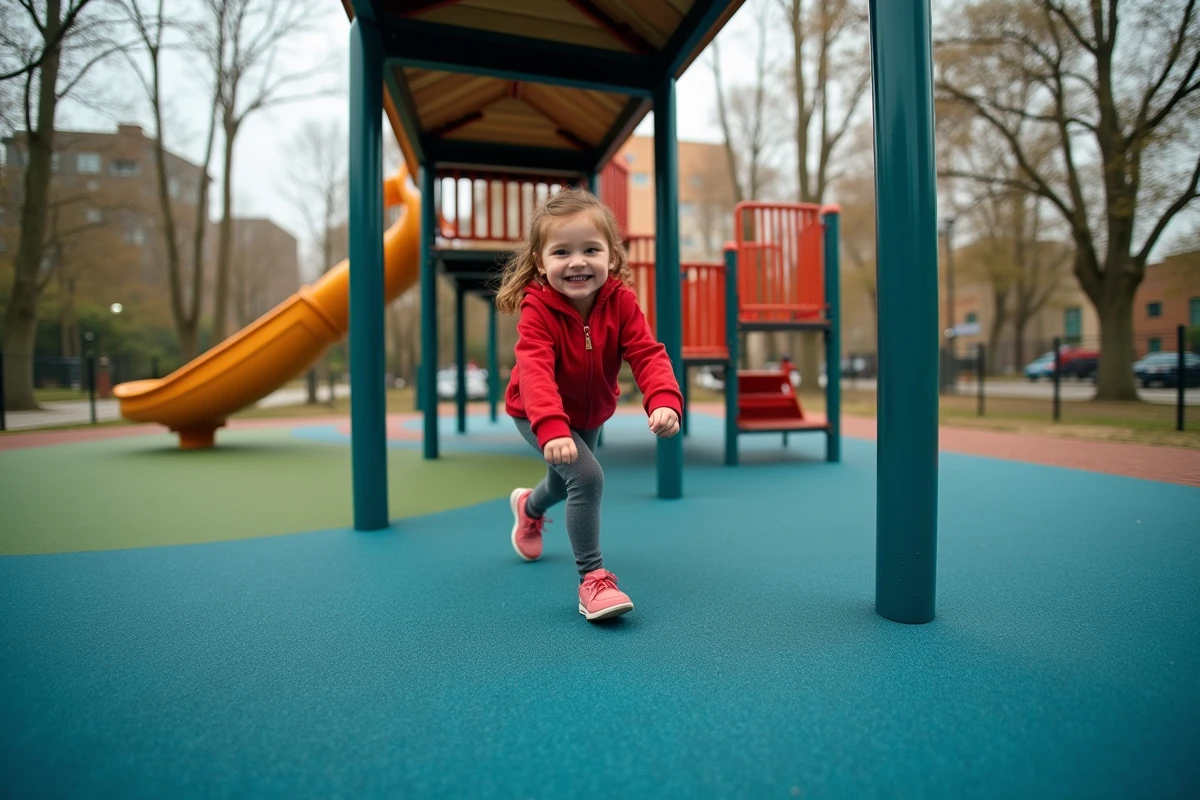
A shock-absorbing surface for playgrounds refers to any flooring material capable of absorbing the energy of an impact during a fall. Its performance is measured by the critical fall height, the value beyond which the ground no longer sufficiently protects a child’s head from serious injury. This technical parameter dictates the choice of surface long before any aesthetic or budgetary considerations.
Critical fall height and EN 1177 standard: the technical foundation to understand
The European standard EN 1177 defines the testing method that allows for the determination of the critical fall height of a safety surface. The principle is based on an impact test simulating the fall of a child’s head: a weighted instrument is dropped onto the surface, and then the acceleration and duration of the transmitted shock are measured.
If the installed equipment generates a free fall height greater than the absorption capacity of the surface, the flooring is considered non-compliant. Each play configuration (slide, climbing structure, swing) produces a different free fall height, and the surface must be sized according to the highest equipment.
Compliance is not limited to laying a “soft” material. It is necessary to check, for each receiving area, that the thickness and density of the surface correspond to the actual free fall height. The same product may be compliant under a swing set and insufficient under a taller climbing tower. Choosing a suitable shock-absorbing surface for playgrounds therefore requires cross-referencing the manufacturer’s data with the specific characteristics of the installed equipment.
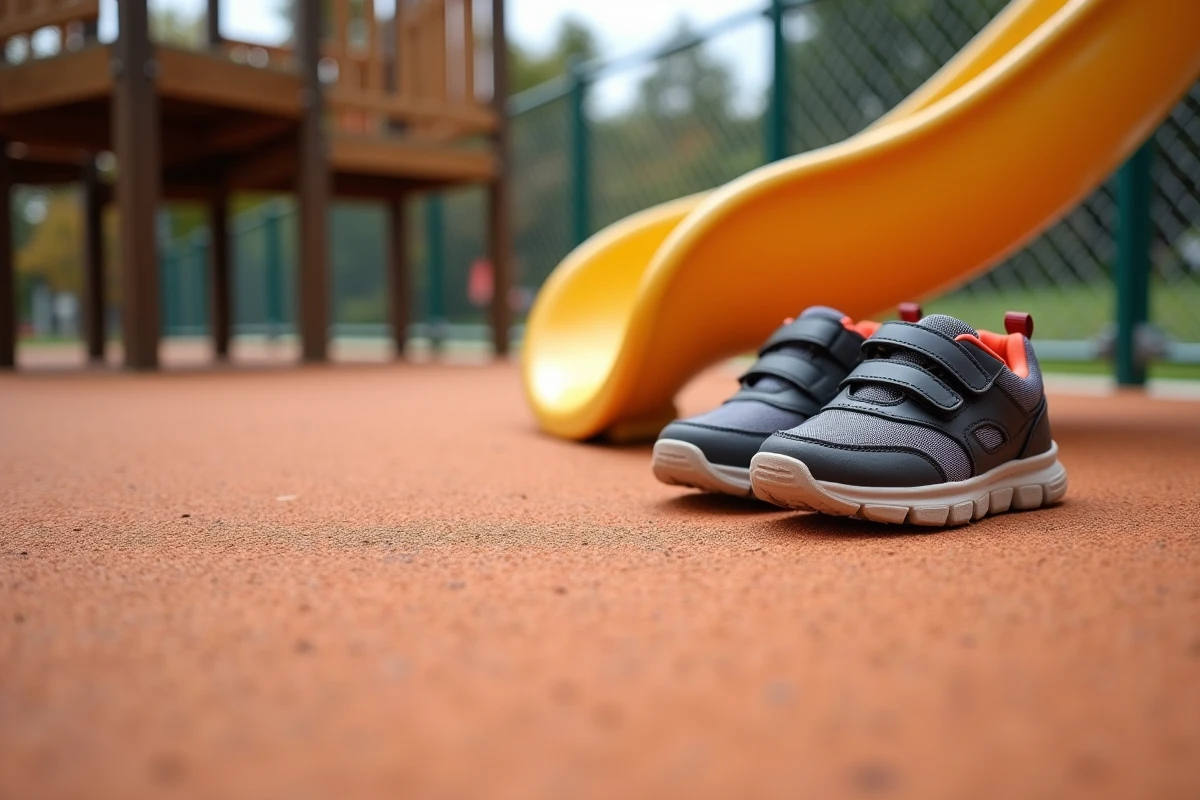
EPDM surface, rubber tiles, or wood chips: what each material really absorbs
The three main families of shock-absorbing surfaces are not equal on the ground. Their impact behavior, aging, and maintenance diverge significantly.
Poured EPDM surface
EPDM (ethylene-propylene-diene monomer) is applied continuously over an elastic underlayer. The resulting surface is smooth, homogeneous, and seamless. This surface offers a superior thermal and sensory comfort compared to tiles: no edges, no level discrepancies, consistent contact under bare feet.
Its absorption capacity directly depends on the thickness of the underlayer made of recycled rubber granules. Maintenance is limited to water cleaning. However, local repair after degradation (vandalism, tree roots) is more complex than with modular tiles.
Shock-absorbing rubber tiles
The tiles are laid on a flat and stable surface. Their modular format allows for the replacement of a damaged element without having to redo the entire area. They are well-suited for small spaces or configurations where the surface needs to be disassembled occasionally.
The weak point: the joints between tiles. Over time, sand, water, and temperature variations can cause gaps, creating areas of reduced absorption and roughness. Regular inspection of the joints is essential.
Wood chips and natural materials
Wood chips or natural granules (crushed fruit pits, for example) offer a low-cost alternative. Their shock-absorbing capacity is real, provided that the thickness of the layer is maintained over time. However, bulk materials shift due to play and foot traffic. The receiving areas at the foot of slides or swings become hollow, and the thickness decreases precisely where it is most needed.
- Poured EPDM prioritizes homogeneity, sensory comfort, and surface durability, but requires a higher initial budget.
- Modular tiles facilitate targeted maintenance and adapt to evolving configurations.
- Natural chips reduce installation costs but require frequent replenishment to remain compliant.
Accessibility and inclusivity: an often-underestimated flooring criterion
A shock-absorbing surface does not only protect against falls. It also determines who can access the playground. An uneven surface (gravel, thick chips, loose sand) blocks wheelchairs and complicates walking for children with reduced mobility or elderly companions.
Continuous surfaces like EPDM or certain tightly jointed tiles allow for smooth circulation for wheelchairs and strollers. This parameter is increasingly significant in the specifications of local authorities, which must comply with accessibility obligations in public spaces.

Making a playground inclusive is not just about installing a ramp. If the surface prevents a child in a wheelchair from reaching the play equipment, the setup remains exclusive. Therefore, the choice of surface comes into play right from the design phase, not as an afterthought.
Aging of shock-absorbing surfaces: what changes after a few seasons
The performance of a shock-absorbing surface is not fixed over time. Several factors degrade its absorption capacity:
- Prolonged exposure to UV rays gradually stiffens the elastomers, reducing surface flexibility.
- Repeated freeze-thaw cycles weaken rubber tiles, especially at the joints.
- Settling of the underlayers decreases the effective thickness, thus the actual critical fall height of the surface.
- Accumulation of debris (dirt, leaves, moss) alters the surface texture and may mask underlying degradation.
A surface compliant at installation may become insufficient after a few years without appropriate maintenance. Periodic verification of the critical fall height remains the only reliable way to ensure that the surface still fulfills its role. Some managers have standardized impact tests conducted at regular intervals, rather than relying on the visual appearance of the surface.
The shock-absorbing surface of a playground is not an installation that you set and forget. Its compliance depends as much on the initial quality of the material as on ongoing monitoring, and the only indicator that matters remains the critical fall height measured on-site, not the one indicated on the product sheet at delivery.